
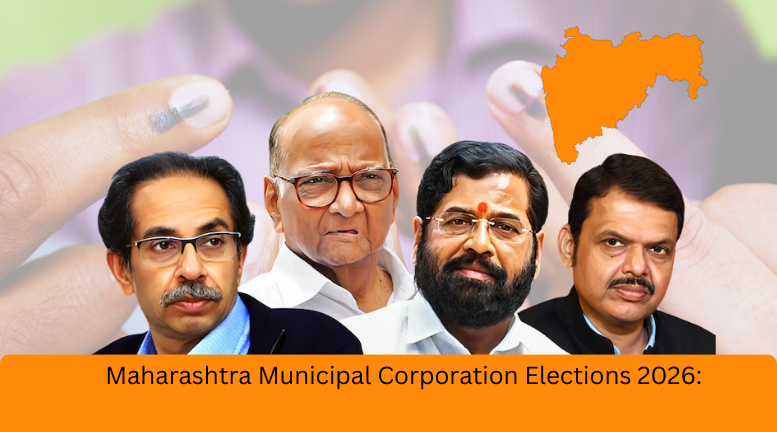
Maharashtra Municipal Corporation Elections 2026: Deadline Day Sparks Statewide Political Turmoil, Alliances Crack Across Cities
The final day for filing nomination papers for the 2026 Maharashtra Municipal Corporation elections witnessed unprecedented political drama across the state. With elections due in 29 municipal corporations, December 30 turned into a high-voltage day marked by last-minute negotiations, broken alliances, open rebellions, and parallel power centres within major political parties.
Candidates rushed to submit nomination papers clutching party authorization (AB) forms, while disgruntled aspirants who were denied tickets rebelled openly, filing as independents or resigning from parties altogether. The chaos highlighted deep internal rifts within alliances and signalled fiercely contested, multi-cornered battles in most urban centres.
As per the election schedule, candidates can withdraw nominations until January 2, voting will be held on January 15, and counting across all 29 corporations will take place on January 16.
Mumbai: Rebellion Peaks in India’s Richest Civic Body
In the Brihanmumbai Municipal Corporation (BMC), the political battlefield is clearly drawn among three main blocs — the Thackeray brothers’ camps, the Shiv Sena–BJP alliance, and the Congress–Vanchit Bahujan Aghadi front.
The final day saw intense scrambling for AB forms across all major parties. Several senior leaders and grassroots workers, denied official tickets, revolted. Multiple rebel candidates emerged from both the BJP and Shiv Sena factions, while the Shinde-led Shiv Sena maintained secrecy till the very last moment over its official nominees. The scale of rebellion suggests internal discipline will be a major challenge for all parties in Mumbai.
Pune: Alliance Confusion and Controversial Nominations
Pune witnessed one of the most confusing political spectacles of the day. Early in the morning, leaders from the Shinde-led Shiv Sena declared the BJP–Shiv Sena alliance broken. Hours later, contradictory statements from senior leaders claimed talks were still ongoing, plunging party workers into confusion.
As a result, BJP and Shiv Sena candidates filed nominations independently across wards. Meanwhile, Ajit Pawar’s NCP distributed tickets throughout the day, triggering controversy by fielding candidates linked to criminal cases. With no clear alliance structure, Pune now heads into a five-cornered contest, making it one of the most unpredictable civic battles in the state.
Thane: Clear Camps, Heavy Mobilisation
Thane saw a massive rush of candidates on the last day. The political picture here is comparatively clearer:
- Shinde Sena and BJP are contesting together
- MNS, Thackeray Sena, and Sharad Pawar’s NCP are aligned
- Congress and Ajit Pawar’s NCP are fighting independently
Seat-sharing figures indicate an intense contest, with every major party seeking dominance in what is considered the political bastion of Chief Minister Eknath Shinde.
Chhatrapati Sambhajinagar: Alliance Collapse and Emotional Protests
The most dramatic scenes unfolded in Chhatrapati Sambhajinagar, where the Shiv Sena (Shinde) formally announced a break with the BJP. This was followed by angry protests at BJP offices after ticket distribution.
Several women aspirants accused senior BJP leaders of unfair practices, with incidents of fainting and even an attempted self-immolation shocking party workers and police alike. The city also saw widespread criticism over family-centric ticket distribution, as multiple senior leaders fielded close relatives.
Parbhani: Fragmented Contests and Worker Anger
In Parbhani, the deadline closed at 3 pm amid visible dissatisfaction among party cadres. BJP, Shiv Sena, Congress, and both NCP factions have all fielded large numbers of candidates, with alliances breaking down ward-wise.
Several senior leaders’ family members received tickets, while grassroots workers were sidelined, leading to independent nominations and internal resentment that could significantly impact results.
Nashik: Ticket Chaos, Police Security, and Allegations
Nashik saw high drama as BJP ticket distribution required heavy police protection. There were allegations of a “black market” for party tickets, with aspirants chasing vehicles carrying AB forms.
Despite internal anger, the BJP-led alliance finalised its seat-sharing arrangement, while the Maha Vikas Aghadi (MVA) also entered the fray with a coordinated but competitive structure. Nashik is shaping up to be a direct BJP vs MVA showdown.
Nanded: Partial Alliances, Silent Resistance
In Nanded, the BJP and Shinde Sena formed an alliance with Ajit Pawar’s NCP, but internal opposition remained strong. Congress and Vanchit Bahujan Aghadi joined hands, while the Thackeray Sena stayed out of this alignment, ensuring a fragmented contest.
Kolhapur: Rare Unity for Mahayuti
Kolhapur stood out as the only major city where the Mahayuti (BJP–Shiv Sena–NCP Ajit Pawar) managed to stay united. Even here, however, multiple rebel candidates emerged from all major parties, signalling voter-level volatility despite formal alliances.
Jalna: MVA Together, Mahayuti Divided
In Jalna, the Maha Vikas Aghadi (Congress, Thackeray Sena, Sharad Pawar’s NCP) is contesting together, while BJP, Shinde Sena, and Ajit Pawar’s NCP are fighting separately. High-profile family candidatures once again drew public attention.
Amravati, Latur, Solapur, Sangli, Dhule, Chandrapur, Akola: Localised Battles, Broken Deals
Across these cities, a common pattern emerged:
- Failed alliance talks
- Parties opting for solo fights at the last minute
- Rebellion by denied aspirants
- Multi-cornered contests replacing bipolar equations
In Akola, BJP and Ajit Pawar’s NCP managed to stitch together an alliance at the eleventh hour, leaving the Shinde Sena isolated. In Latur, BJP announced it would contest all seats independently, signalling a complete breakdown of the Mahayuti locally.
What Lies Ahead
With nomination withdrawals due by January 2, parties still have a narrow window to control rebellion and recalibrate strategies. However, the sheer scale of internal dissent suggests that many urban contests will be decided less by alliances and more by local equations, rebel candidates, and voter fatigue with traditional power structures.
As Maharashtra heads toward polling day, one thing is clear: the 2026 municipal elections will be among the most fragmented, unpredictable, and fiercely fought civic battles the state has ever seen.